The digital payment debate has officially landed in wedding planning. Couples tip via Venmo, Zelle, and PayPal all the time now. But for wedding vendors specifically, the method matters more than you might think — because the wrong payment type can mean the tip never reaches the person who actually served you.
Here’s the practical breakdown.
Cash: still the gold standard
Cash is the default for almost all wedding tips, and for good reason. It’s immediate, universal, and bypasses every middleman.
When you hand a bartender a $50 bill at the end of the night, they walk away with $50. No processing fees, no waiting for a transfer, no company account to route through. The money moves from your hand to theirs, period.
This matters most for service workers — catering staff, bartenders, hair and makeup artists, valet attendants, coat check workers, delivery crews. These are the people who depend on tips as a meaningful part of their income, and for whom cash is the most reliable path.
Use cash for:
- All catering and banquet staff
- Bartenders
- Hair stylists and makeup artists
- Valet and transportation drivers
- Coat check attendants
- Any vendor you’re tipping at the moment of service (delivery, setup)
Get the bills from the bank the week before the wedding — don’t scramble the morning of. Our tip calculator can tell you the exact denominations to request.
Checks: personal, but situational
Checks are fine for vendors you have an ongoing relationship with and who are clearly the business owner. Your wedding planner you’ve worked with for a year, your officiant, your florist.
The pros: checks feel personal, leave a paper trail, and can carry a larger amount without the awkwardness of handing over a thick envelope of cash.
The cons: some vendors prefer not to deposit a check explicitly labeled “tip” for tax reasons. And if you forget to write it (which is easy at the end of a 14-hour wedding day), it doesn’t get handed out.
Use checks for:
- Wedding planner (when you know them well and they own the business)
- Officiant (especially for religious ceremonies where a donation check to the church is more appropriate)
- Any vendor where you’ve confirmed they’re comfortable with a check
Venmo / Zelle / digital: use carefully
Digital payments work — but only in specific scenarios, and with one critical caveat: the payment must go directly to the individual’s personal account, not to a business account.
If you send a Venmo tip to a photographer’s personal Venmo, they receive it directly. That’s fine.
If you send a Venmo tip to the “catering company” account or a DJ’s business Venmo, that money goes to the company first. Whether it eventually reaches the employee who served you depends entirely on the employer. In many cases, it doesn’t.
This is the same reason that adding a tip to your credit card payment at checkout rarely benefits service staff — the money goes to the business, which may distribute it, keep it, or fold it into wages at their discretion.
Digital payments are OK when:
- You’re tipping the business owner directly (photographer who owns their business, independent DJ)
- You have confirmed their personal payment handle (not a business account)
- The vendor uses digital payment as their preferred method (some DJs and planners do)
- It’s a backup — you forgot cash and they explicitly offer their Venmo
Avoid digital payments for:
- Service staff at a catering company, venue, or hospitality group (money goes to the company)
- Any situation where you’re not 100% sure the vendor owns their business
- In-person service staff on the day of the wedding (just use cash)
Credit card: almost never works
Adding a tip to a credit card payment in the wedding context is rare and unreliable. Most wedding vendors invoice and collect payment before the event — you’re not swiping a card at the end of the night like a restaurant check.
For caterers and venues that do process card payments, tip line items on cards go through the business account. Unless you’ve confirmed in advance that 100% of credit card tips go to staff, don’t rely on this.
The exception: if a vendor’s payment terminal has a tip line and you’re making a day-of payment (like tipping a shuttle driver who accepts card), that can work fine.
The practical system that works
The best approach for most couples:
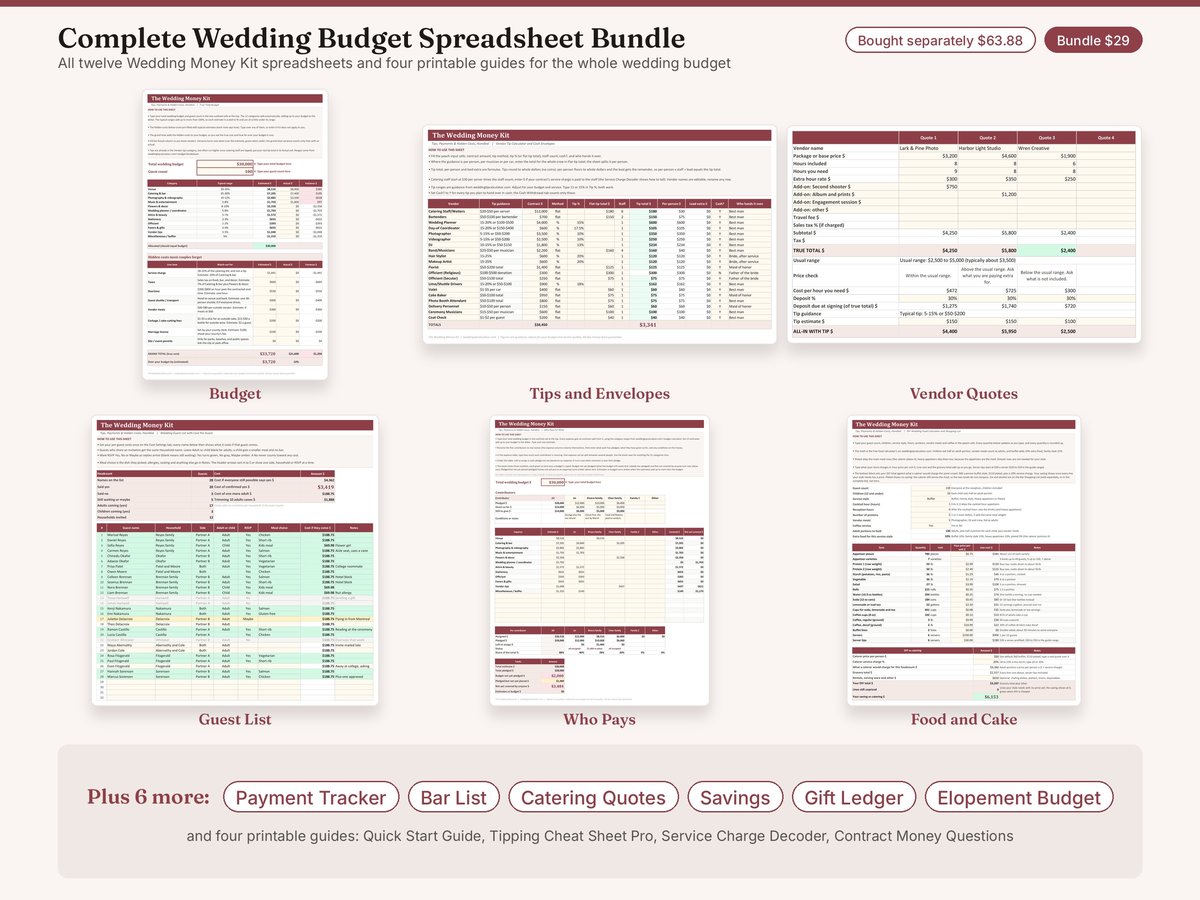
- Run the calculator — get your tip amounts for all vendors
- Visit the bank early in the week before the wedding — withdraw the total in a mix of small and large bills
- Prepare labeled envelopes the night before — one per vendor, with the name and amount written on the outside
- Give the envelope set to your coordinator or a trusted family member — they handle distribution throughout the day while you focus on getting married
This eliminates every day-of decision about who gets what and how. Everything is pre-sorted, labeled, and ready to hand over.
If you want to follow up with digital tips after the wedding (a nice gesture for vendors who really delivered), that’s a bonus, not a substitute.
Ready to get exact amounts? Use our free calculator to see what you owe each vendor, plus the exact cash denominations to request from the bank.